

QWSG Members banding shorebirds © 2010 QWSG
QWSG activities are helping to achieve ongoing conservation of shorebirds. See our Studying Shorebirds section to see how we’re achieving this. Studies are showing a decline in shorebirds and the information being collected can be used by government to make greater efforts to protect shorebirds and their habitat.
Mapping of shorebird roosts by QWSG allows local governments to develop their local government areas with the high tide shorebird roost sites buffered from disturbance. Our consultancy page has some examples where we’ve worked with local government and other bodies to achieve this.
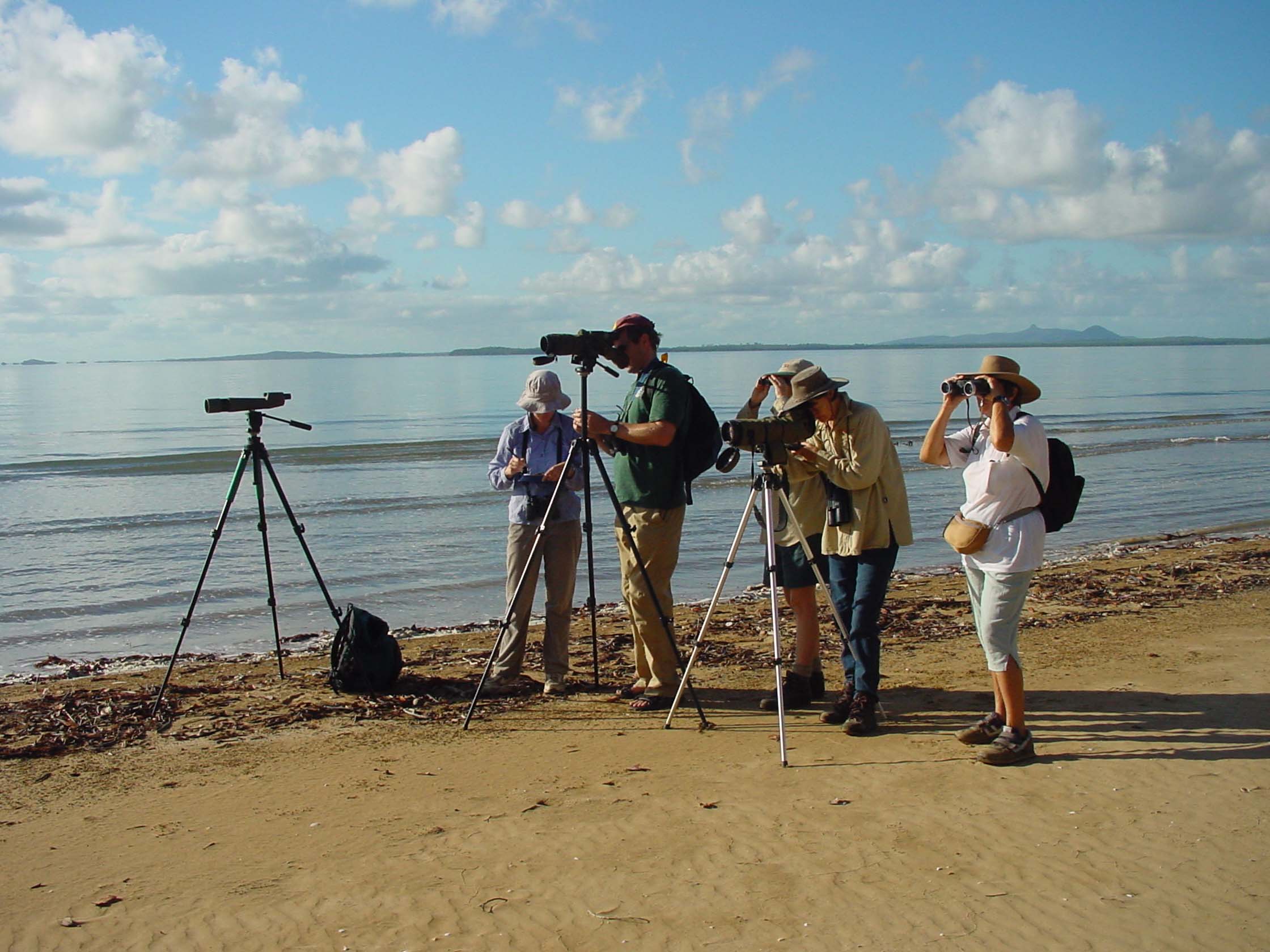
QWSG Members surveying roost sites © 2010 Maureen Cooper
To improve people’s behaviour when they are impacting on shorebirds, QWSG has a number of education activities. Dog walkers have been provided with Doggie Breakfasts at Maaroom in the Great Sandy Strait, and there are always future educational activities planned. The Brisbane City Council has undertaken dog on-leash enforcement at Nudgee Beach and QWSG has provided free dog leashes and information about problems of shorebird disturbance at Nudgee Beach to help with this initiative.
Shorebirds being migratory are very threatened in a number of countries, not just in Australia. Australia is a signatory to several international agreements to enable a flyway approach to shorebird conservation. Birds Australia has a shorebirds 2020 program to improve the data available and to develop greater efforts by countries within the flyway. The Shorebird 2020 website can be accessed from our links page.
The Australian Wader Studies Group (AWSG), see our links page, is also working on programs and activities in countries in the flyway such as China, Korea and USSR. . The AWSG produces a quarterly newsletter: the Tattler. It has recently discussed the issue of the gap between science and conservation.
For an interesting read on the threats to shorebirds have a look at the articles linked at the bottom of this page .
Resident shorebirds and terns that nest on beaches have specific conservation problems, including 4wds on beaches, unleashed dogs, boat and jetski traffic and loss for nests from trampling. In particular the Beach Stone Curlew is vulnerable to intensive disturbance.
To help with shorebird conservation you can join the QWSG and participate in counts and other activities, see our becoming a member page.
Links to other information on Shorebird Conservation
The Queensland Department of National Parks, Recreation, Sport and Racing provides information about shorebirds on their web site:
Shorebird Management Strategy – Moreton Bay
http://www.nprsr.qld.gov.au/parks/moreton-bay/pdf/shorebird-management-strategy.pdf
Shorebirds
http://www.nprsr.qld.gov.au/parks/moreton-bay/zoning/information-sheets/shorebirds.html
The Queensland Department of Environment and Heritage Protection provides information about wetlands on their web site:
Fact sheets -Moreton Bay – a wetland of international significance
Fact sheet – Moreton Bay – celebrating 20 years as a wetland of international importance
Poster showing Queensland’s 5 Ramsar sites
Queensland’s wonderful wetlands brochure
Information about Ramsar
http://wetlandinfo.ehp.qld.gov.au/wetlands/management/national-international-important-wetlands/
Wetland Management Profiles
http://wetlandinfo.ehp.qld.gov.au/wetlands/resources/publications/fact-sheets/
Refer to the legislation web site for the Nature Conservation Act 1992
https://www.legislation.qld.gov.au/LEGISLTN/CURRENT/N/NatureConA92.pdf
Climate change is the big issue for everyone. Broader problems of overconsumption, unequal distribution of wealth and poor government regulation are surfacing as important conservation problems. After the Copenhagen Conference where few countries have signed the Copenhagen Accord which has not included a target to ensure peak in emissions, further negotiations are now needed.
An interesting web site to refer to is:
Bolivia World People’s conference on Climate Change and the rights of Mother Earth – referendum http://cmpcc.org/ English http://pwccc.wordpress.com/